 WhatsApp
The most fundamental principles of hair transplantation is the idea known as donor dominance. Dr. Norman Orentreich first described this concept in 1959. It refers to the ability of hair follicles to preserve the characteristics of their original donor area. Even after transplantation, these features remain unchanged at the recipient site.
In this method, the hair surgeon extracts the hair follicles from the occipital (back of the scalp) and temporal (side of the scalp) areas of the patient’s scalp. This is mainly because the hair in this region is genetically resistant to hair loss. Therefore, these follicles are used to transplant bald areas, referred to as the recipient sites.
The kind of questions that patients are asking most these days, like ‘Will the transplanted hairs fall out again?’ or ‘Are the results permanent?’, are already addressed by the resistance of the grafts to balding in the donor area.
As the Dr. Resul Yaman Hair Transplant Clinic in Istanbul, we have answered the key questions that form one of the fundamental principles of hair restoration surgery in this blog.
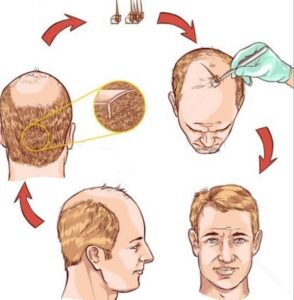 The scientific premise behind the biological theory of permanent hair transplants is the genetic programming of the hair follicle.
Androgenetic alopecia, also known as male pattern baldness, develops due to the hormone DHT. Dihydrotestosterone primarily affects hair follicles in the crown, mid-scalp, and frontal regions.
However, the hair follicles in the occipital region are resistant to DHT. This resistance is carried with the hair follicles. The hair transplant physician harvests these grafts directly from the patient. In their new environment, they remain unaffected by external factors. Therefore, they continue to express their intrinsic genetic characteristics. For this reason, specialists consider hair transplantation a permanent solution.
However, the presence of donor dominance by itself doesn’t always lead to success. It’s essential for the hair transplant surgeon and the team to implant the hairs at the right angle, with the appropriate density, and in a way that doesn’t affect the blood flow. If not, even strong hairs will produce weak results, although they possess strong genes.
Although the genetic resistance of donor hair is a strong principle, the donor area is finite resource. Overharvesting may result in the exhaustion of this biological advantage.
A successful hair replacement procedure requires more than a strong donor area. It also depends on a hair surgeon who can manage the donor region effectively. There are various points that need to be kept in mind by the expert while using the principle of donor dominance. These include avoiding over-harvesting, minimizing trauma, and creating a personalized treatment plan.
The technique used (FUE, DHI, or Sapphire FUE) is also equally important as the expertise of the team performing the procedure. A balanced donor area with natural density and keeping in mind the upcoming procedure may demand a professional and visionary approach. Otherwise, the permanent hair may fail to deliver aesthetically pleasing results.
At present, researchers are advancing permanent hair graft characteristics beyond traditional hair transplantation. The hair colonization technique tries to use donor hair in a more efficient way. However, scientific studies on hair colonization are still ongoing. At present, this technique is not advanced enough to be considered a completed procedure.
Stem cell therapy, on the other hand, aims at enhancing the biological potency of the donor area and the recipient area. Clinicians often address whether stem cell therapy supports hair regrowth. Some clinics apply stem cell–based treatments for hair growth. However, current medical evidence does not sufficiently prove their effective use in hair transplantation.
Applications related to stem cells may have supportive roles with respect to healing and reduction of shock loss. But they should not be regarded as a solution that can replace donor dominance.
PP405 is an experimental molecule that works on the activation of the stem cells present in the hair follicles. It has been of immense interest in clinical research for its potential use in the augmentation of the density of the hair, as well as the reactivation of the miniaturized follicles. It has no effect on the biological basis for permanent hair restoration but can be used for the improvement of the quality of the existing hair.
Researchers developed Clascoterone 5% as a topical anti-androgen for dermatologic use. It is still under investigation in hair-related clinical and experimental studies. The intended use of this product is to decrease the effect of DHT on the hair follicles. Clinicians have reported promising results with this product. However, they have not yet established definitive long-term clinical data for its use after hair transplantation.
Although donor dominance theory has long been accepted as a basic principle of hair plant surgery, it has also been a subject of certain debates among scientists and practitioners over time. Dr. O’Tar Norwood, a specialist who developed Hamilton and Norwood’s method of classifying hair loss, was among the first who challenged this theory.
In his clinical observations, he noted that in a non-wavy hair follicular unit, there were texture variations following transplantation to a recipient area that originally grew wavy hair. This indicated that the recipient area possibly affects some features of the hair.
In 2005, researchers transplanted hair from the occipital region to the leg and observed slower growth. They later transplanted the same hair back to the scalp and recorded different growth rates. This indicated that the tissue in the recipient sites has the potential to affect the biological behavior of the hair follicle.
From a hair transplant clinic perspective, these studies do not fully invalidate donor dominance.
Instead, they suggest that the concept should be evaluated in a more nuanced manner. Nonetheless, transplanted hair from the donor area clearly retains its resistance to DHT. This remains the foundation of permanent hair restoration in androgenetic alopecia.
The genetically resistant donor follicles are the scientific concept behind permanent, natural hair plantations. However, the success of the scientific concept depends entirely on the donor dominance, the surgical procedure, and the artistic vision of the surgeon. When science, surgical expertise, and artistic vision come together, they produce truly successful results.
In Istanbul, Dr. Resul Yaman is one of the leading specialists for Turkey hair transplant with his trustworthy, scientific, and artistic approach. As official verification of his credibility, Dr. Resul Yaman is listed on the Health Türkiye website under the Turkish Ministry of Health.
His treatment process avoids over-harvesting. Dr. Yaman further explains the results through documented before-and-after photographs. For patients aiming for an enjoyable and smooth process within their Turkey hair transplant cost package, they can discover all the information through their free online consultation.
 Get Mail!