Using Beard Hair Follicles as a Donor
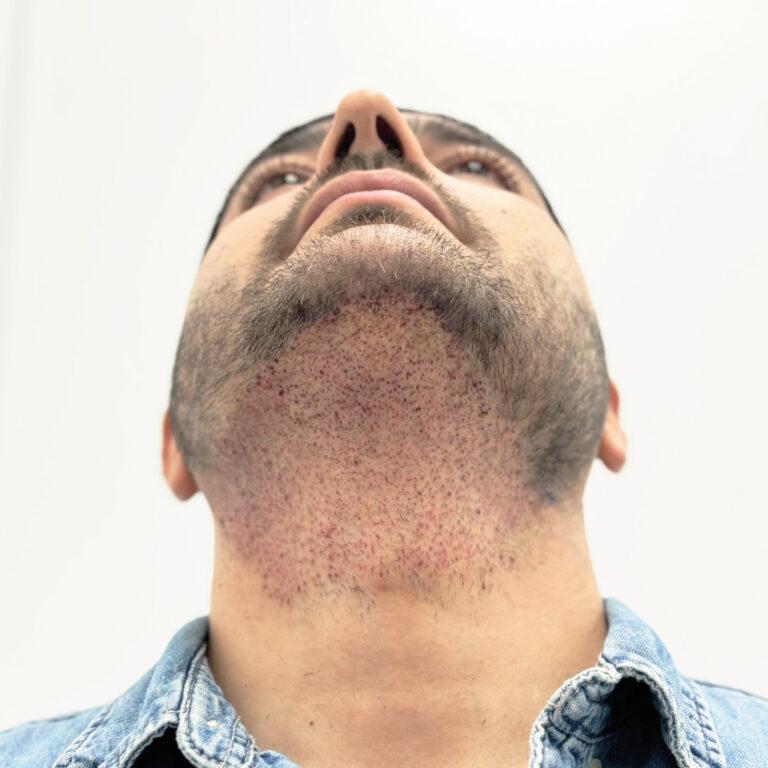
If you have a lack of hair follicles in the occipital area, the next place where doctors can find additional follicles is the beard area under the chin. The most suitable donor area for extraction in case of beard hair is the area under the chin and cheeks beside ears. Under-chin hair is the most suitable for extraction because it is farther from important nerves and less visible. Cheek areas beside ears can also be used if more grafts are needed for extraction.
The area around lips, chin and area towards jawline is highly movable during speaking, smiling, and eating. Hair follicles from these areas should not be used for extraction. In addition, extraction scars can heal slower or get bigger in these areas because of high mobility of these locations. Also, the great attention should be paid to the avoidance of nerve injury because of hair follicles extraction. Extraction in areas near nerves such as cheeks beside ears should be done by specialists with experience in this kind of procedure with the help of fine punch.
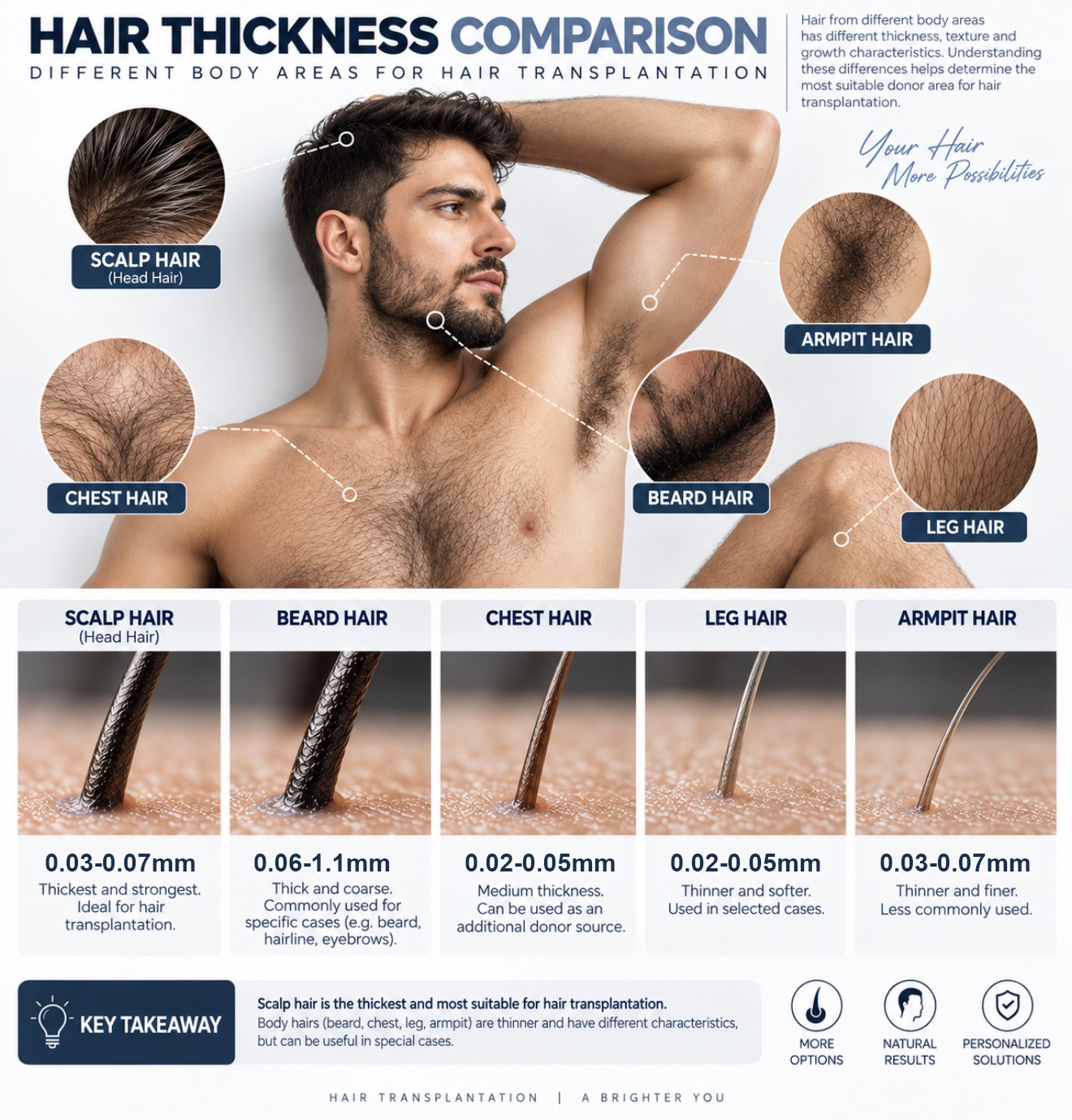
The most important thing about the beard hair is that it is thicker than scalp hair. Beard hair is also usually curly. That is why beard hair should not be used in visible frontal and mid-scalp areas. Beard hair should be used only in crown and posterior crown areas. However, only beard hair grafts will not be enough to cover these areas. They should be combined with scalp hair that was harvested from the occipital area. While determining how densely beard hair should be used, differences in color and structure of these and scalp hair should be considered [1]. In case of very noticeable differences, grafts can be implanted in ratio of 2 scalp hairs to 1 beard hair, or 3 scalp hairs to 1 beard hair.
The thick beard hair with curly texture needs certain angle and direction during its implantation. If only beard hair is implanted to crown area without correct angle, the natural result will not be achieved. Actually, in this case, the patient may need to use some styling products such as wax or hair spray in order to move this hair aside.
Beard hair has the growth rate close to the growth rate of scalp hair, which is the advantage of using this hair as a donor source. Beard graft survival rates are also close to survival rates of scalp hair follicles. However, due to the thickness and large delicate bulbs of these hair follicles, they may be more sensitive to any traumas. Therefore, in case of implantation of beard hair grafts to the scalp, it is necessary to use DHI implanter . It means that hair graft should be inserted to the scalp while being inside a tube. Large and delicate beard hair grafts may be damaged when they are held with the help of forceps.
Chest Hair as a Secondary Donor Source
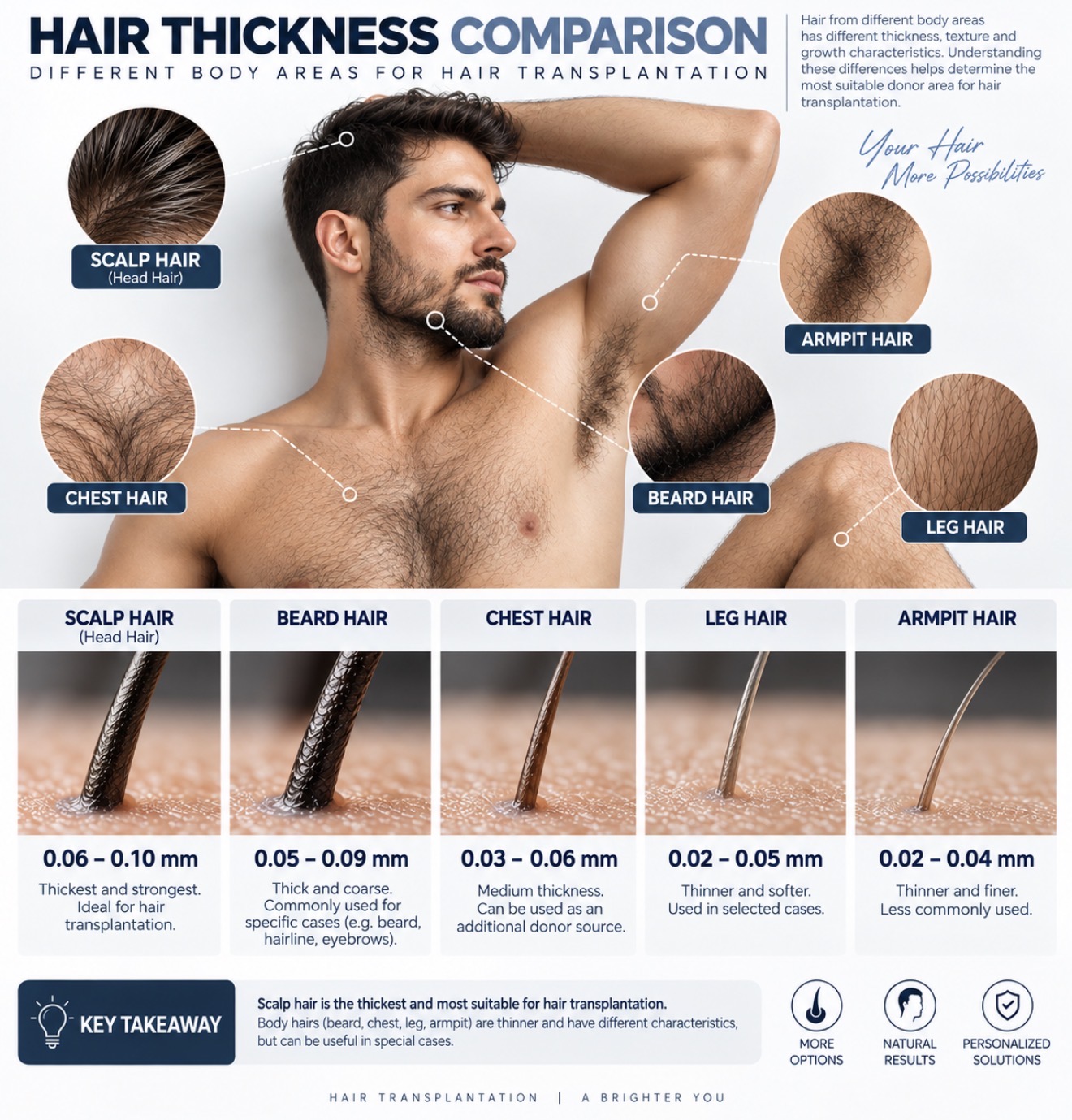
Chest hair is one of secondary donor options after beard hair. Men usually regard chest hair as the strongest one. However, chest hair is one of the finest and most delicate body hair. It is almost half as thin as scalp hair. Also, due to the very slow growth rate, the specialist should thoroughly evaluate whether chest area is suitable as a donor area.
Chest hair can be used in mid-scalp and crown except for frontal area. This extraction is much more complicated than extraction from back of the scalp or beard because of the existence of soft skin layer above the fat layer in the chest area. Thus, it can be hard to stabilize this area while using punch during hair extraction. As a result, hair extraction together with its follicular bulb may become problematic. While planning chest hair extraction, it cannot be guaranteed that each punch will succeed in extracting hair and its follicular bulb. For instance, in case of 1,000 punches, only 500 usable grafts can be obtained. It is the disadvantage of chest hair extraction.
The chest area moves with each breath of a person. Thus, the healing of extraction scars may take longer in comparison with scars in scalp donor area and beard donor area. Patients with tendencies to keloid formations may form more noticeable scars on the chest area. Due to the thinness of chest hair, approximately 25 chest hair can give the same volume as 10 scalp hair in the occipital area. Chest hair can be used for increasing hair density and fullness at the roots. It should not be used separately to cover some area of the scalp because it grows less long than scalp hair. Thus, it should be mixed with scalp hair.
What Other Body Hairs Can Be Used for Hair Transplantation?
Since it is not possible to perform a hair transplant from another person , there are alternative donor sources that can be used in cases where the primary and the secondary donor sites are insufficient. There are three other parts of body that can be used as donor area for hair restoration. First, it is leg hair. It is thinner and more difficult to extract in comparison with chest hair. However, it can be used to increase the hair density in selected areas.
Pubic area is quite limited in size. This hair is thick and similar to beard hair. However, the HPV is highly prevalent in the genital area. These viruses can incubate under the skin without being noticeably visible, and a doctor might not detect this during an examination. If the pubic hair is used as donor hair in such cases, the HPV infection will spread to the scalp hair area. It also can be technically difficult to work with pubic area. That is why it is generally not used for hair grafting operation.
Armpit hair is curly and thin in comparison with the other hairs. Thus, it can be difficult to extract hair from this area. In addition, this area is anatomically important because of the presence of nerves. That is why extraction should be made with greater care. Each axillary follicle is connected with sweat gland. If hair is extracted from this area, after extraction these glands should be separated microscopically from hair structure. In this case, only the hair shaft and follicular structure are used for the implantation. Due to these additional actions, the procedure takes more time, and only limited amount of hair can be extracted.
Conclusion
“Transplantation of body hair in to scalp has been suggested as an option to treat extensive cases of baldness with poor donor scalp [2].” Because this surgery can use different donor sources, it will differ slightly from procedures that only use the back of the scalp. The cost of hair replacement procedure generally depends on the number of grafts needed and the size of covered area. However, due to the complexity of extraction from chest and other areas, the cost can also be determined according to the duration of procedure.
The following table shows practical comparison of donor areas.
| Parameter | Scalp Donor | Beard Donor | Chest Donor |
|---|---|---|---|
| Thickness | Medium–thick | Thickest | Finest |
| Extraction ability | ~95% | ~82–83% | ~55% |
| Survival rate | ~90–95% | ~85% | ~50% |
| Longevity | ~85% – potentially lifelong | ~80% – potentially lifelong | ~60% – potentially lifelong |
| Best recipient areas | Frontal, mid-scalp, crown | Crown | Mid-scalp and crown |
Donor hair taken from body and beards is another option for use in the treatment of androgenetic alopecia[3]. But one needs to consider that this kind of hair does not alter its color, texture, or caliber. So, careful planning is required for the different kinds of donor hair transplantation [3]. At Dr. Resul Yaman Hair Transplant Clinic in Istanbul , donor planning is carried out considering preservation of scalp donor reserves and avoidance of overharvesting. Beard and body hair can be used in case of insufficient scalp donor reserves, especially in case of advanced hair loss or previous transplantations.