 WhatsApp
Female hair transplant is a targeted surgical technique designed to improve overall scalp density in women who are thinning, have a wide part, a receding hairline, or areas of temporal recession. Unlike males, who tend to lose hair in balding patterns, females lose hair in a diffuse manner over their entire scalp.
Therefore, different medical considerations will need to be addressed when determining whether an individual has sufficient density to be a suitable candidate for surgery, including donor site, hairline design and long-term hormonal evaluation. If these factors are carefully assessed, a natural density correction can be achieved.
In recent years, female hair transplant in Turkey has gained attention among international patients due to structured medical protocols and cost-effective treatment models.
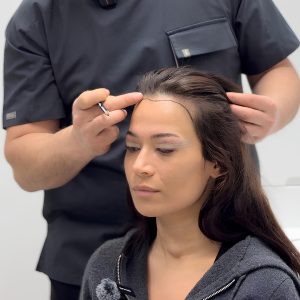 Female hair transplant is a surgical procedure aimed at correcting the pattern of hair loss in females by transplanting healthy units of hair from a donor site to the recipient site. The surgical procedure is most suited in cases requiring female pattern hair loss transplant. The surgery is most ideal for patients who have a steady donor hair density but experience a receding hairline or traction alopecia.
Successful women hair implant procedure planning begins with identifying the underlying cause of female hair loss. Not all types of female hair loss can be treated with hair replacement surgery.
Androgenetic alopecia in women, commonly referred to as female pattern hair loss (FPHL), is the most frequent reason that they seek surgical treatment for hair restoration. FPHL is a progressive form of hair loss characterized by gradual thinning of the central portion of the scalp while keeping the frontal hairline intact.
It is associated with androgen sensitivity and genetic disorders. Unlike males, females do not suffer from complete baldness but a progressive decrease in the hair density.
Diffuse thinning is characterized by a general reduction in density. However, there may be regions of localized hair loss in the following areas:
Localized hair loss is more amenable to transplantation than diffuse unpatterned alopecia (DUPA), where the donor area may be unstable.
Can women with diffuse thinning undergo hair transplant surgery? Only if the donor area is stable and shows minimal miniaturization. Diffuse unpatterned alopecia will most likely experience an acceleration of the thinning process if not carefully evaluated.
Before any surgical procedure, patients must be evaluated for any underlying hormonal and systemic conditions that could compromise the hair growth cycle. As per the American Academy of Dermatology, the following are some of the common medical conditions that cause female hair loss.
Both hyperthyroidism and hypothyroidism can affect the hair follicle’s metabolic activity, resulting in diffuse thinning of individual’s hair. Ferritin (iron stored in your blood) has been shown to affect the anagen phase of the hair growth cycle and result in hair shaft weakness.
The imbalance of hormone levels, as observed in PCOS, may lead to female pattern hair loss due to the miniaturization of the hair follicles. Stress, illness, and postpartum disease can cause active shedding of the hair. It is essential to rule out the inflammatory diseases that are already present in the scalp before undergoing hair restoration surgery.
Hair restoration surgery in Turkey for women should not be conducted on a patient who is actively losing hair. It is essential to stabilize the medical condition before surgery to ensure a successful graft survival and density.
The answer to that depends on the donor area’s stability and how much density can be created. A qualified hair transplant surgeon should perform an examination of the patient and determine whether surgery is appropriate or not.
The density of the donor site in females is normally less compared to that in males, and in addition, the process of miniaturization may also extend to the so-called “safe” donor site. Therefore, a complete trichoscopic analysis is a prerequisite before any surgical procedure. The trichoscopic analysis is necessary for the following:
Overharvesting of grafts should be avoided, especially in cases of diffuse thinning, as this may affect the aesthetic appeal of the donor site and may not be correctable in the future.
Although there is no strict age limit, the process is usually advised only after the pattern of hair loss has been stabilized. In the case of young patients, there may be a need to adopt conservative planning in order to preserve future donor potential.
In clinical practice, the women hair restoration procedure requires conservative graft distribution due to the higher likelihood of diffuse thinning.
The procedure may take 6-8 hours depending on the number of grafts.
Yes. The transplanted hair follicles are less prone to hormonal hair loss because they are harvested from genetically stable areas. After the procedure, they remain permanent, growing according to a natural cycle.
The technique of choice depends on the preference for shaving, the number of grafts, and the density.
FUE is the most preferred technique for women. The technique involves the extraction and implantation of individual follicular units without linear scarring.
Benefits:
Sapphire FUE is a technique that uses sapphire blades to create more precise recipient sites. This may allow for:
The DHI technique is a hair implant technique that uses implanter pens without opening the recipient sites.
The benefits of the DHI technique for women include:
Although not as popular as other techniques in current practice, FUT is still a technique for high-graft procedures. However, the linear scar is a drawback for women.
Hairline aesthetics for women are worlds apart from male hair transplantation.
The female hairline is typically:
Single-hair units are placed to create a natural transition zone.
In cases where the forehead is prominent, hair plantation procedures can be considered as an alternative to forehead reduction surgery. Finding the right doctor for hairline design is crucial here.
Temporal angle correction is a highly sensitive procedure in females and is sometimes combined with female hairline correction.
The healing process in females undergoing hair restoration follows a predictable biologic cycle. Although the rate of healing may differ from individual to individual based on the vascularity of the scalp, the number of grafts, and hormonal factors. An understanding of the healing process enables the patient to have realistic expectations and to realize that the temporary loss of hair is a natural part of the biologic cycle.
There will be some redness and some crusting (or scabs) around the transplanted grafts due to the healing process. This redness and crusting will usually settle down on its own within 7-10 days.
There will be some temporary swelling on your forehead due to fluid accumulation during the procedure. This will typically go away after a few days.
The transplanted follicular units (grafts) will be anchored to the surrounding tissue and establish microvascular connections that are vital to the survival of the grafts.
Strict adherence to post-operative care instructions during this period will greatly influence graft survival.
There will be a temporary shedding of the transplanted hairs due to the shock of the surgical procedure, which will cause the transplanted hairs to enter the telogen (resting) phase all at once.
The growth of new hairs will start as the follicles start to enter the anagen (growth) phase again. At this point, the hair growth may be fine, light-colored, or slightly unruly in direction before becoming normal and thick later on. The thickness of the area would also increase as more follicles become active.
The final density, thickness and maturity of the transplanted follicles are reached once they have grown through their full cycle. This allows the transplanted and existing hairs to fully blend together and gives you a long-lasting aesthetic result.
Although females can get a hair transplant safely, they may experience short-term side effects after surgery or have some surgical risks that are uncommon, such as:
The success of a female hair transplant procedure largely depends on precise surgical planning and donor stability.
Typically, before-and-after hair transplantation outcomes demonstrate an obvious improvement in both the degree of frontal density, the area of the part line and the hairline following evaluation of the stability of donor sites.
Standardized medical photographs taken at 6–12 months following the procedure typically demonstrate increased hair thickness and improved scalp coverage. These clinical findings are further supported by documented real patient outcomes, reflecting the importance of precise graft placement, correct angulation, and long-term donor stability.
Costs depend on the complexity of surgery, as well as the service package. The following are the main factors to consider:
Female hair transplant in Turkey is often structured as an all-inclusive medical package rather than a per-graft pricing model. The package service may include airport transfers, hotel accommodation, city transportation, surgery, post-operative care, interpreter costs, and medical care products such as shampoo and lotion.
The table below provides quick information on hair replacement procedure for women.
| Category | Details |
| Procedure time | 6–8 hours |
| Anesthesia | Local |
| Recovery | 7–10 days |
| Shedding phase | Weeks 3–6 |
| Visible growth | Month 3 onward |
| Final results | 9–12 months |
| Typical graft range | 800–2500 grafts |
Cosmetic hair restoration in Turkey requires individualized planning, advanced surgical expertise, and extensive medical work-up. Unlike male hair transplantation, the presence of diffusely thinning areas and donor site limitations requires a prudent and strategic approach.
When performed in experienced centers, including specialized clinics offering female hair transplant in Turkey, the procedure provides predictable and long-term density improvement. For comprehensive evaluation and individualized surgical planning, patients should seek assessment at experienced medical centers such as Dr. Resul Yaman Clinic.
When selecting a candidate and establishing a stable donor site, the graft survival rate is typically between 90%-95%.
The cost of hair transplants is dependent on the selection of the technique, number of grafts, the surgeon’s expertise and geographic location. Many facilities charge either per graft or by way of an all-inclusive package.
When performed on candidates who have stable (i.e. non-progressive) hair thinning, it offers a lasting and natural correction to density. This leads to very high degrees of patient satisfaction.
Hair follicles are resistant to hormonal influences that cause hair loss, and thus the transplanted hair will be permanent and grow for the duration of a woman’s lifetime.
The female hair transplant procedure is performed using local anaesthetic which means there will be no pain associated with the surgery. The only discomfort after surgery will be mild and temporary.
This is not necessary for all women. Depending on the number of grafts required and the method of transplant (e.g., FUE, DHI), partial shaving or the use of unshaven techniques may be suitable.
 Get Mail!