 WhatsApp
Donor area selection plays a direct role in the success of a hair transplant procedure. Traditionally, the back of the head has been viewed as the most important donor area; however, there may be insufficient donor hair available to complete a successful transplantation for some patients who require hair restoration.
Therefore, body and beard hair can be considered viable options in certain situations. Because of the importance of properly evaluating potential donors for transplanting, the use of body and beard hair helps expand the chances of achieving successful hair restoration for those individuals with advanced levels of hair loss.
At Dr. Resul Yaman Hair Transplant Clinic in Istanbul, we address this topic within the framework of medical science and based on scientific evidence.
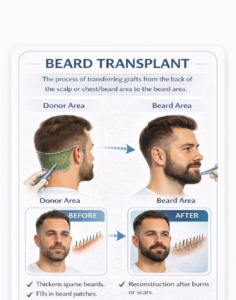 Beard hair is one of the most common secondary donor sources in hair restoration procedures. This is primarily due to its thick, robust quality. Additionally, beard donor hair follicles have a longer anagen (growth) phase, which contributes to their higher success rate when transplanted as grafts. The submental and neck regions are considered suitable beard donor areas.
Beard hair has a greater diameter than that of hair found on the scalp. This characteristic provides an advantage in areas that require higher density, such as the crown. However, the use of beard hair in the frontal hairline is limited. Texture differences may affect a natural appearance in the frontal area.
The extraction of grafts from beard hair requires a certain level of expertise. If the grafts are not extracted with the proper angle or depth, it can greatly increase the chance of developing visible scarring. As such, beard hair must only be harvested by an experienced medical professional.
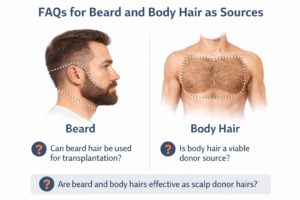
Body hair represents a tertiary donor source in hair replacement surgery. The clinically recognized body donor sites are generally the chest, armpits, pubic area , and legs; however, this body hair may not be appropriate for all patients because of the differences in their length and growth cycle when compared to scalp hair.
The anagen phase for body hair is also significantly shorter than that of scalp hair, resulting in the fact that body hair does not grow as long as scalp hair. Body hair is primarily used for supportive purposes, either to increase density or to fill any gaps.
It is important to evenly distribute body hair follicles during hair plantation; otherwise, differing textures of the hair will have a negative effect on the aesthetic appeal. In addition to this, careful planning to ensure the appropriate ratio of body hair to scalp hair is critical for providing the best possible result.
These donor sites are applicable to patients with advanced baldness. The need for donor sites arises with Norwood classification of androgenic alopecia as type 6 and 7. It can also be applicable to individuals with previous hair transplant surgery.
Beard hairs are a good choice for patients with an insufficient scalp donor area. In a patient with a good beard area, the number of follicular units may be enhanced. Body hairs can be considered with limited expectations.
At this stage, patient expectations need to be managed well. It is not appropriate to consider beard and body hair as a miracle cure. However, a good outcome is definitely achievable with proper planning.
 Beard and body hair are usually extracted using the follicular unit extraction technique. Micromotor or manual punch systems may be preferred. The diameter of the punch used will depend on the characteristics of the hair to be harvested. Using this technique allows for minimal scarring.
Natural transitions are targeted during graft distribution. Beard grafts are generally placed in the mid-scalp and crown areas, while body hair will usually be evaluated to provide additional density where needed.
The experience of the surgeon is very important at this stage of the procedure. If a graft is placed incorrectly, it can create an undesired textural mismatch between the grafts and the existing hair. For this reason, each patient’s hair restoration plan must be customized to achieve optimal hair restoration results.
The technical complexity of performing beard and body hair transplants requires direct involvement of a physician. An experienced physician must determine the angles, depths, and the types of donor grafts used.
The structural and growth characteristics of beard and body hair compared to scalp hair are significantly different. Conducting procedures in a professional hair restoration facility guarantees medical and safety compliance while achieving consistent surgical results.
Planning performed by a physician reduces donor site scarring and provides the best possible chance for graft survival. The best natural and long-term results attainable from body and beard hair transplants are only possible with the extent of direct physician supervision.
The main advantages are the provision of good quality donor hair. This widens the avenues of treatment, particularly for those patients with extensive bald areas. The beard follicles may also show strong survival due to their robust structure.
The disadvantages include limited growth potential. Body hair does not grow like scalp hair. Texture differences may also affect the natural look and feel. Minimization of risks is very possible with proper planning.
Patient education is paramount at this stage. Realistic expectations heighten overall patient satisfaction.
Hair replacement with use of the beard and body hair requires close follow-up for long-term results. These hairs retain their initial biologic properties. Speed of growth and length of the hair may be different from scalp hair. These details should be discussed with the patient pre-operatively.
When proper patient selection is made, satisfaction rates are high. Realistic expectations are the most important part of the process. Aesthetic success is not limited to the day of surgery. Long-term planning and follow-up ensure lasting satisfaction.
The Dr. Resul Yaman clinic performs this procedure by considering medical science and also focuses on ethical standards. The aim is for every patient to have safe, natural-looking, and long-lasting results.
Body and beard hair transplantation in Turkey require advanced surgical planning. This method should be evaluated differently from standard hair implant procedures. Donor area structure, hair thickness, and hair growth cycles need to be examined in detail; poor planning can result in an unnatural looking outcome. Thus, a comprehensive evaluation by an experienced physician is essential.
At the Dr. Resul Yaman Hair Transplant Clinic, the use of beard and body hair for donor sources is scientifically evaluated. A customized donor map is generated for each patient; the expected number of grafts, distribution, and angle at which they will be implanted are all planned prior to surgery. The goal is to give the patient an aesthetically pleasing and natural appearance long-term.
 Get Mail!