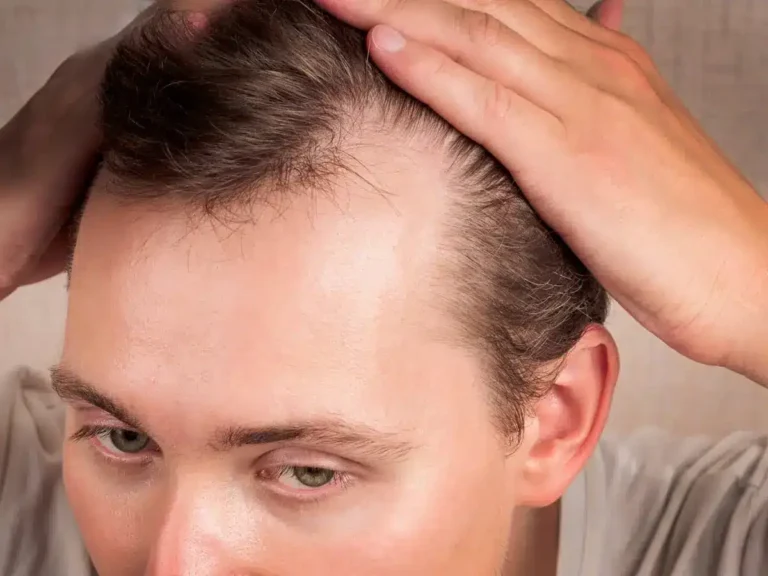

One of the first things most people notice about themselves, and instantly begin to question, is an M-shaped hairline. It’s characterized by a middle section of hair that sits a little lower, with the temples pulling back and creating a clear M-like shape.
This can be accredited to genes, hormones, or natural changes that may occur with age. People frequently view their frontal hair region in comparison to those of others, and as a result, it is easy to confuse the normal variations between those of other people with hair loss.
An individual may have an “M” shaped pattern, which may not correspond to a permanent increase in hair loss. It is essential to understand how this type of hairline will continue to change. This awareness will help you determine the appropriate long-term care and/or treatment regimen you require.
What is an M-Shaped Hairline?
 The M-shaped contour is indeed a marked pattern where, viewed from the front, the hair border a clear “M.” Whereas the temples draw back, the middle stays a bit forward, thus the shape becomes more defined.
It is a type of junction between the forehead and scalp common in individuals with a genetic tendency toward androgenetic alopecia, but this sometimes is only the natural pattern. Whereas this may be identified as early as puberty in some cases, in others it becomes gradually more visible with age.
Though it happens to both men and women, it is more frequent in men. The M-shape is therefore synonymous with the early phase of male pattern thinning.
M-Shaped Hairline Versus a Widow’s Peak
Most people make the mistake of confusing the M-style recession pattern with a widow’s peak; however, they are not the same.
A widow’s peak is one single point of hair that dips down the middle of the forehead where the sides curve in softly. However, with an M-shaped hairline, the temples show stronger recession. This makes the outline sharper and more angular.
A widow’s peak in general is just a natural trait and has little to do with hair loss. As you observe changes to your frontal contour, an “M” shaped pattern may indicate the beginning of follicle miniaturisation. Being able to distinguish between these changes is important. This helps you more accurately understand the health status of your hair.
What Causes an M-Shaped Hairline?
The cause of the M-shaped pattern may be most commonly due to the impact of hormones on hair follicles. Greater amounts of DHT increase the sensitivity of follicles around the temples and hasten thinning and recession.
This can also be known as telogen effluvium, which can be brought about by stress, sleep problems, or emotional ups and downs. In some cases, this could provide an appearance of a sharper M-shape. The frontal scalp margin tends to move slightly upward with age; often, this develops into a shape that resembles early thinning.
Genetics also plays a significant role, as the speed and visibility of these changes are influenced mainly by what runs in your family. For this reason, we observe the pattern in some people earlier.
Does an M-Shaped Hairline Mean You’re Going Bald?
Having an M-shaped hairline is not a sign of going bald in most cases, but it can be an early indication of male pattern hair loss. Indeed, where there is a more notable recession at the temples, this often corresponds to the early stages of the Norwood scale.
In some, this takes place during the teenage years; in others, at a much later stage. And it is much less common for females to have an M-shaped hairline; however, in general, this is due to genetic or hormonal influences.
Since everyone’s rate of hair transformation is unique, the best way to find out what is actually going on is to observe it regularly and consult a professional.
Maturing Hairline vs. Receding Hairline
A maturing hair line is a normal transition that occurs with aging. It usually shifts upward and then stops. On the other hand, a receding hairline keeps progressing. It is often linked to thinned hairs and deeper temple recessions.
A mature hairline rarely moves behind the level of the ears. A receding hairline may continue moving backward through several stages. In women, true recession is uncommon. When it occurs, it may result from underlying medical or hormonal disorders.
Knowing whether this is just maturing or receding will help you in taking appropriate action towards its care.
Bottom Line: Treat Your Hair Loss at Dr Resul Yaman Hair Clinic
If someone has an M-shaped hairline that keeps progressing and wants permanent results, a hair transplant is most effective. Techniques such as FUE and DHI are performed at the Dr Resul Yaman Hair Clinic. These methods help create a hairline compatible with one’s face shape.
These Turkey hair transplant techniques allow for the precise placement of follicles that results in a full and aesthetic appearance. One can schedule a consultation to review your hair type, the extent of your thinning, and what treatment modalities suit you. With the right kind of plan, one’s hairline can be restored in a very reliable yet natural way.