What is Beard Hair Transplant?
During the beard hair transplant, the hair follicles are harvested from the donor site with the help of the follicular unit extraction (FUE) technique. Then the follicles are transplanted into the recipient beard areas.
Beard hair has the thickest shaft among the hairs found on the human body. The occipital and temporal scalp areas are primarily chosen as donor areas. However, when a patient has a dense beard area, it can also be chosen as a donor area. In this case, hair can be transplanted from the denser part of the beard to its sparser area.
The area under the chin is usually one of the denser parts of the beard. Hair follicles can be extracted from this area according to a diluted donor plan and generally transplanted toward the sparse edges of the beard. In this way, the desired beard contour can be created.
In case of the presence of sufficient body hair, it can be chosen as a donor area too. However, the body hair is generally finer and, therefore, less effective. It can be considered only when the other donor sites are limited.
How is Beard Hair Transplant Performed?
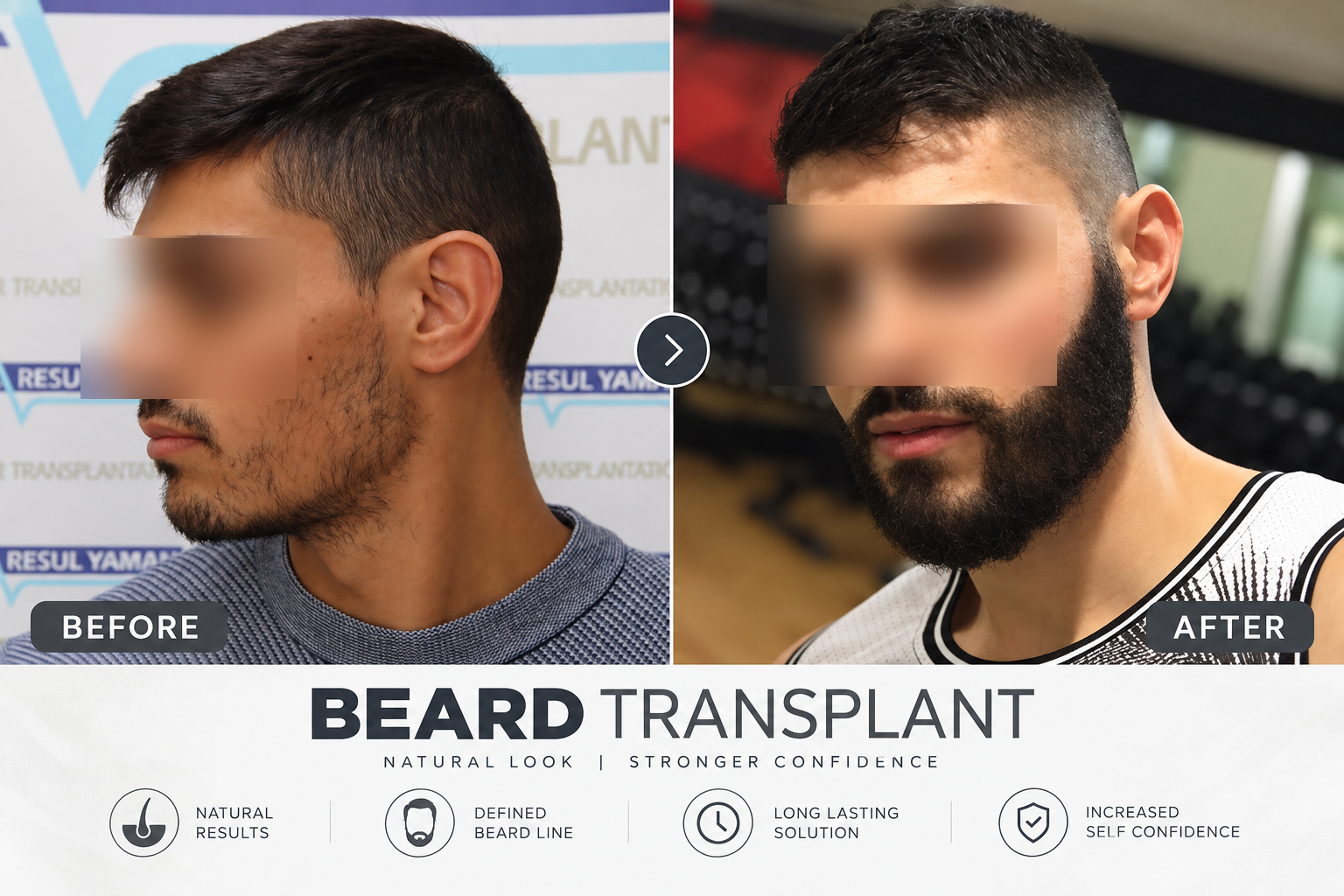
“In the field of hair restoration, there has been a significant increase in demand with patients for facial hair transplantation procedures [1]. Modern techniques in hair transplantation allow for facial hair transplantation and for the attainment of natural-appearing results [1].” However, there are several significant differences between beard transplantation and scalp hair transplantation. The beard hair follicles mostly consist of single-hair grafts, while the scalp donor areas mostly include multiple-hair grafts.
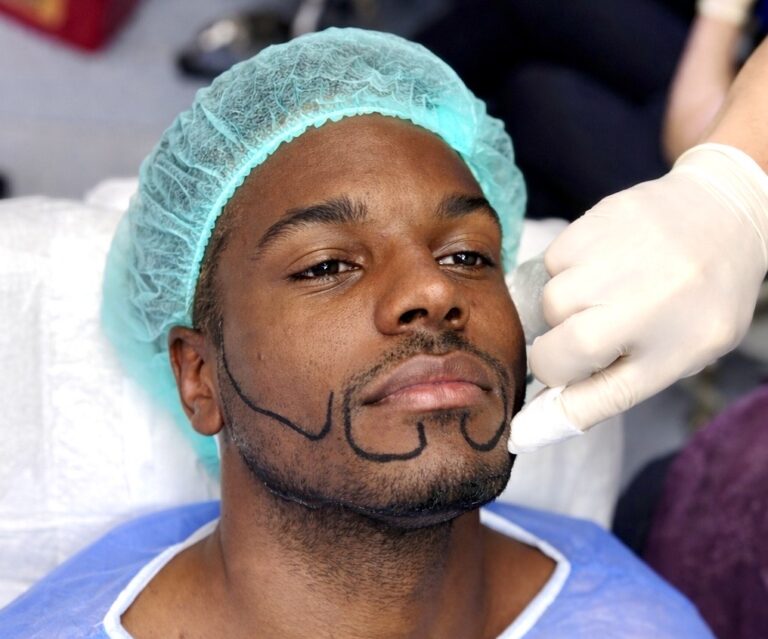
During the examination, the doctor draws the desired beard contours for the patient . Additionally, bald or thinning areas are identified according to their surface area in cm² [2]. This allows calculating the required number of the grafts. The FUE technique is used for harvesting and the required number of grafts is extracted[2].
When the procedure is planned, the outer 1.5-2 cm border of the beard contour must consist of single-hair grafts. The use of multi-hair grafts in these zones will lead to an unnatural appearance. Therefore, the single-hair grafts play a vital role in creating a natural outer beard contour[3].
The double-hair grafts can be used in the central areas [3]. However, the selective use of double-hair grafts is required. The scalp hair is finer and straighter than the beard hair. Therefore, it is hard to obtain the desired beard density using only single-hair grafts. In case of necessity, double-hair grafts can be used to achieve the adequate density.
When a patient has sufficiently thick hair and the required number of grafts is not high, all the harvested grafts can be transformed into single-hair grafts and a larger number of single grafts can be implanted per cm². However, this increases the labor intensity of one session. After the extraction, there is a need for the extra work of separating multi-hair grafts into single-hair grafts. Moreover, the denser implantation pattern should be used for obtaining the sufficient volume.
This procedure can be carried out when the hair shafts are thick. When the hair shafts are medium or fine, the use of double-hair grafts is necessary. The triple or quadruple grafts should not be used in the central areas. They may lead to the pitted appearance. Therefore, the micro-incisions should be applied in these areas without exceeding the two-hair grafts.
The Roles of FUE and DHI in Beard Transplantation
As beard hair restoration is performed on the most prominent part of the body, the face, it requires a meticulous approach. Even the smallest technical mistake can be seen and influence the final result negatively. Even a minor design mistake in one of the beard parts may become visible. Therefore, the use of a minimally invasive technique is important in this case for reducing the scarring risk.
While DHI is highly effective for scalp hair restoration, it is not as easily applicable to beard restoration, making it a less optimal and practical choice. During the implantation, stretching the skin is difficult as the facial skin has a softer structure. The pressure created by the implanter can shift adjacent grafts. This makes dense implantation becomes harder. Nevertheless, if the DHI is carried out, the skilled doctor and his surgical team are essential.
The FUE hair transplantation technique is preferable for the beard grafting [4]. The 1 mm or 1.5 mm blades can be used during the scalp hair transplantation, but using the same size of the incision in the beard zone is the medical error. However, in the beard zone, the grafts can be comfortably transplanted through 0.4-0.5 mm micro-incisions using the forceps. As the facial skin is soft, the grafts implantation through these incisions is considerably easier. Therefore, the size of the incision must be kept as small as possible in order to avoid visible scarring. A man undergoing beard restoration can sometimes want to shave and keep a clean-shaven appearance in daily life. With minimal scarring, the face will not acquire an abnormal appearance in this case when the patient shaves.
The gravity influences the downward growth direction of beard hair, establishing the correct angle and direction remains important. Unlike the scalp hair, the beard hair grows at a much sharper angle. If the grafts are not implanted at this precise natural angle, the results will look unnatural, and the beard will become prickly to touch. The proper alignment will ensure that the new hair will blend properly with any already grown facial hair.
In summary, the natural and permanent beard transplant result requires the skills of an experienced doctor and surgical team. The use of the FUE hair transplantation technique is also important in this case[4].

Who Can Have a Beard Hair Transplant?
Restoration of beard can be carried out for:
- Men dissatisfied with the shape or density of their beard.
- Individuals who have sparse or lack beard but have sufficient donor area.
- Patients who want to hide acne scars, wounds, traumas, or scars resulting from accidents [2].
- The patients with alopecia areata who do not respond to the treatment for a long time can be candidates for the beard transplantation[2].
The beard restoration cannot be performed in patients having conditions like alopecia totalis due to absence of suitable donor area. Although the visible appearance of the beard is formed usually at the age of 18, the beard density and full maturation of male facial hair can take place until approximately 23-24 years of age. For this reason, the planning of the beard restoration at younger ages can be inappropriate.
Risks of Beard Transplantation
The potential risks include:
- Scarring.
- Facial nerve injury remains a risk if the procedure is not performed by a qualified physician and an experienced medical team.
- Infection and ingrown hair development can take place.
- The triple-hair grafts usage at the outer edges of the beard can lead to the unusual and unnatural appearance due to their outward growth.
From an aesthetic perspective, a doctor-involved approach should be followed.
Healing and Postoperative Care
The skin of the beard area is thinner and has the better blood circulation than the scalp skin. For this reason, the beard transplantation healing process proceeds faster than the scalp hair transplantation one. The regrowth also takes place faster than the scalp hair regrowth. Besides, the survival rate of the grafts is higher. Due to the thinness of the skin and good blood circulation, almost all the implanted grafts survive.
The beard area should be washed regularly for the first 10 days. During this period, the crusts disappear and fall off. About 12-13 days after the surgery, the short-beard appearance can be achieved. Except for the hyperemia and reddish appearance of the transplanted area, the face looks quite normal.
The shock loss occurs during the first month. The cutting methods, like scissors or an electric trimmer, should not be used for the first month. The first beard trimming can be performed with scissors approximately 45 days after the surgery. About 3.5 months after the procedure, scissors, an electric trimmer, or razor can be used for shaving.