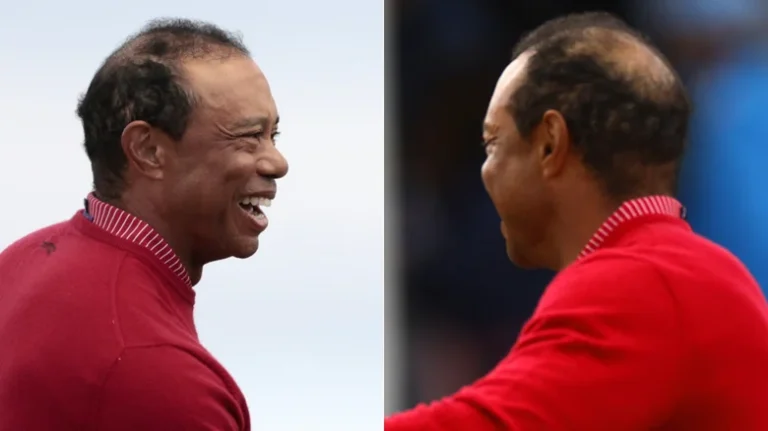
Before diving into the Tiger Woods hair transplant journey, it’s essential to look at his natural hair characteristics at ages 19 and 20.
In the year 1994, the golf superstar, at the age of 19, had slightly curly hair-not very curly, but enough to cover the scalp. While his visible hair had a slightly curly appearance, the follicle patterns allow for straight hair growth, which is beneficial in hair transplants.
His overall hair density appears relatively preserved In recent years. However, there is mild weakness in the temporal area.
In 1995, he had a widows’ peak with a balanced hairline. This was evident when he was 20 years of age. From a clinical perspective, our team at Dr. Resul Yaman Hair Clinic has analyzed how his hair evolved over time.
Norwood 2 Stage Hair Loss
 In the early-to-late twenties, there are clear changes visible within the hairline and thickness of Tiger Woods’ hair. There is a mild front-temporal recession visible in this set of photographs.
While it is still sparse, this recession certainly represents a more noticeable condition than during his late teenage years. However, the donor site on the back of his head remains full and dense, a clear marker of an excellent donor supply which would be ideal in supporting potential Tiger Woods hair transplant procedures.
As years pass, hair density decreases near the sideburns, and subtle miniaturization reaches the frontal zone. This youthful, rounded frontotemporal corner becomes thinner, resulting in a mature, angular front hairline. Clinically, this hair loss pattern aligns with early androgenetic alopecia and fits the Norwood 2 classification.
Managing Hair Loss During the Recession Phase
For many men, this age marks the recession phase, where hair loss accelerates rapidly. Medical therapy and future surgical options must be considered early.
Finasteride and Minoxidil remain the cornerstone medications for treating androgenetic alopecia. Recently, research and development of drugs such as PP405 or Clascoterone 5% have been explored by some scientists in their research studies. It will soon be determined if this research will prove to be useful in treating androgenetic alopecia in the future.
Receding Hairline, Temple Loss, and Forehead Enlargement
Tiger Woods’ hair thinning becomes more noticeable and defined in his early to mid-thirties. Progressive thinning affects the frontal scalp, appearing weaker than both the mid-scalp and crown areas.
As is common with male pattern baldness, thinning and recession may begin at several spots. For Tiger’s condition, the area that is noticed early on is the frontal area. The receding hairline further increases the size of the forehead, and the widow’s peak and the finer and curlier hair that defined the hairline diminish.
The continuous reduction of the scalp’s anterior-posterior dimension causes a less curved and more horizontal temple position, increasing the width of the forehead. Additionally, the premature reduction of the scalp’s superior dimension affects the natural shape of the scalp, mainly observed in lateral views.
Tiger Woods Hair Transplant: Signs of FUT Surgery
By his early forties, signs point toward surgical hair restoration, most likely an FUT procedure. His hairline is more prominent at this point in his late thirties, unlike in previous years.
However, when observing the occipital and parietal areas from a side and back perspective, there do seem to be visible signs which may indicate scarring from FUT harvesting. Though FUT has largely fallen out of fashion now, as DHI and FUE have become the choice of the day, it still has its application with carefully selected patients.
Progressive Hair Loss After 40
By age 42, thinning progresses in the crown area. The frontal region remains maintained through hair plugs surgery. This would suggest that his natural frontal hair has progressively miniaturized.
It is important to remember that hair loss does not stop after the age of 35. It simply tends to progress at a significantly slower pace in contrast to the rapid loss during the late twenties and early thirties.
This slow progression will eventually yield a much thinned-out or almost bald result during the years. Therefore, a specialist doctor should plan the appropriate medical treatment or a hair follicle surgery.
Advanced FUT Scarring and Limited Donor Area
Tiger Woods hair transplant scarring appears more pronounced in side-profile images taken at age 43 compared to earlier years. This could be attributed to the progressive thinning seen in the donor area. In fact, it is a characteristic feature in some individuals suffering from diffuse androgenetic alopecia.
Another possible explanation could be the performance of additional FUT procedures. Additional tissue removal around an FUT scar raises tension as scalp flexibility declines. In addition, with age, the widening of the scar tissue would pose a less favorable aesthetic result.
It is also evident at this point that the greater amount of hair on the American sports star’s front scalp is from his transplanted hair follicles. We would estimate the golf icon’s total number of grafts to be about 3000. Most of these grafts have been implanted in his front and partially in mid-scalp regions. The crown area was mostly left untreated.
These procedures permit a visible hairline on Tiger even at the age of 44. It is evident that his hairline design is fairly straight, but more importantly, the line is located at a higher position.
Donor Area Limitations and Density Loss in Later Years
By 45, transplanted hair alone cannot replicate the natural density of Tiger Woods’ original hair. This problem mainly arises from the natural limitations of the donor site present on the back and sides of his head.
The number of hair follicles that can be found in the patients’ donor areas is, whether using FUT or FUE, a finite number. The greater the surface area is covered by a constant number of grafts, the density is bound to decrease as a consequence. The effect is compounded when the original hair is seen to gradually thin, leaving only the grafted hair intact.
Many patients require added density in this particular case, but to undergo multiple procedures adds to the depletion of the donor area. Applying protective measures to the existing hairs pre-and post-surgery by utilizing medical interventions, yields a long-lasting, organic surgical outcome.
Conclusion
As you have read in the Tiger Woods hair transplant example, you must definitely take into account hair restoration once your hair loss has stabilized. Moreover, it is imperative to consider that your chosen doctor and clinic must be endorsed by the Ministry of Health.
For those thinking about taking advantage of hair transplant in Turkey, there is free online consultation available from our clinic. If one would like to see the photos before and after the surgical operations of the well-conserved donor sites, they are available at the works of Dr. Resul Yaman.